
What if scientists could explore millions of DNA fragments simultaneously, identify previously undetected genetic variations, and uncover molecular mechanisms hidden within complex biological systems?
This is the promise of Next-Generation Sequencing (NGS). By enabling high-throughput analysis of DNA and RNA, NGS has transformed how researchers investigate genomes, study gene expression, characterize microorganisms, and explore the molecular origins of disease.
But the next chapter of sequencing is about more than generating genetic data. It is about connecting sequence information with biological function, computational intelligence, and meaningful scientific discoveries.
As sequencing technologies evolve, the integration of long-read analysis, single-cell approaches, multi-omics, and artificial intelligence is opening new opportunities for researchers across the life sciences.
1. From DNA Fragments to Biological Intelligence
Traditional Sanger sequencing remains useful for targeted DNA analysis. NGS, however, makes it possible to analyze millions of DNA fragments in parallel, supporting large-scale investigations that would be considerably more difficult using conventional approaches.

A typical NGS workflow includes several interconnected stages:
Sample preparation: DNA or RNA is extracted and assessed for quality and quantity.
Library preparation: Nucleic acids are processed and sequencing adapters are added.
Sequencing: A sequencing platform generates reads representing the sampled nucleic acid molecules.
Bioinformatics processing: Raw reads undergo quality control, alignment or assembly, and computational analysis.
Biological interpretation: Researchers identify relevant variants, expression patterns, microbial profiles, or other molecular features.
Each stage contributes to the reliability of the final result. Poor sample quality, insufficient sequencing depth, contamination, or inappropriate analytical parameters can affect the conclusions drawn from the data.
The central challenge is therefore not simply to sequence more molecules, but to produce reliable evidence that answers a clearly defined biological question.

2. Short Reads, Long Reads, and the New Sequencing Landscape
NGS is not a single technology. Different sequencing approaches offer different advantages, depending on the biological question and the characteristics of the sample.
Short-read sequencing
Short-read platforms, including Illumina systems, generate large numbers of relatively short DNA sequences. They are widely used for whole-genome sequencing, targeted panels, RNA sequencing, and many other applications.
Their high throughput and established analytical workflows make them valuable for studies requiring accurate characterization of individual bases across large datasets.
However, short reads may be difficult to map in repetitive genomic regions or to use when reconstructing complex structural variations.
Long-read sequencing
Technologies from Pacific Biosciences and Oxford Nanopore Technologies can produce substantially longer reads, helping researchers investigate genomic regions that are difficult to characterize using short-read approaches.
Long-read sequencing can support:
Detection of complex structural variants.
Analysis of repetitive DNA regions.
Characterization of full-length RNA transcripts and alternative splicing.
Haplotype phasing, which helps determine which genetic variants occur together on the same chromosome.
Investigation of certain DNA modifications, depending on the platform and analytical method.
These capabilities are particularly relevant to complex genomes and unresolved genetic questions. Recent research highlights how long-read whole-genome analysis can reveal variation that conventional approaches may overlook.
The most suitable technology depends on the required resolution, sample characteristics, analytical goals, and available resources.
3. RNA Sequencing: Discovering What Genes Are Doing
A genome provides information about the genetic blueprint, but it does not reveal the complete activity of a biological system at a particular moment.
RNA sequencing (RNA-seq) addresses this limitation by examining RNA molecules present in a sample. It allows researchers to investigate which genes are expressed, how expression changes between experimental conditions, and which transcript variants are present.
RNA-seq can help scientists explore:
Differential gene expression between healthy and diseased tissues.
Cellular responses to environmental stress or experimental treatments.
Alternative splicing and transcript diversity.
Molecular pathways associated with disease progression.
Candidate biomarkers for further investigation.
For example, researchers studying oxidative stress could compare RNA-seq profiles from untreated cells, cells exposed to an oxidative insult, and cells receiving a protective treatment.
The resulting data could identify genes and pathways associated with cellular stress responses, inflammation, or antioxidant defense.
However, changes in RNA abundance do not automatically demonstrate changes in protein abundance or biological activity. Transcriptomic results should therefore be interpreted alongside other experimental evidence whenever possible.

4. Single-Cell Sequencing: Looking Beyond Average Gene Expression
Bulk sequencing combines molecular information from many cells. This provides a useful overview, but it can conceal differences between individual cell populations.
Single-cell sequencing offers a different perspective by examining molecular features at the level of individual cells.

In single-cell RNA sequencing, researchers can identify distinct cell populations, investigate cellular states, and examine how cells respond differently to the same biological stimulus.
This approach is particularly useful when studying heterogeneous tissues, immune responses, tumor microenvironments, and developmental processes.
Imagine a tumor sample containing several cell populations. Bulk RNA sequencing might reveal an overall expression signature, while single-cell analysis could help distinguish tumor cells from immune cells and stromal populations.
Such resolution can uncover cellular subgroups that might otherwise remain hidden.
Nevertheless, single-cell experiments introduce their own challenges, including technical noise, variable transcript detection, high computational demands, and the need for careful experimental design.
5. NGS Meets Artificial Intelligence
One of the most exciting directions in modern genomics is the integration of sequencing data with artificial intelligence.
NGS can generate enormous datasets, but identifying meaningful biological patterns within them requires robust computational methods.
Machine learning and deep learning can support several analytical tasks:
Variant prioritization: Computational models can help rank genetic variants according to their potential relevance to a research question.
Pattern recognition: AI can identify complex relationships between sequence features and biological outcomes.
Gene expression analysis: Predictive models can help investigate relationships between gene expression, cellular states, and experimental conditions.
Biomarker discovery: Computational approaches can identify candidate molecular signatures for subsequent validation.
Multi-omics integration: AI can help combine genomic, transcriptomic, proteomic, and other molecular datasets to investigate biological systems from complementary perspectives.

These approaches are developing rapidly, but AI predictions are not equivalent to experimental proof. Model performance depends on data quality, training design, external validation, and the biological context in which the model is applied.
The most useful systems combine computational efficiency with interpretable results and independent biological validation.
6. The Hidden Challenge: Turning Sequencing Data into Reliable Results
Despite its potential, NGS presents important analytical and practical challenges.
Data volume: Large sequencing projects require substantial computational resources and efficient data management.
Data quality: Sequencing errors, contamination, sample degradation, and uneven coverage can affect downstream results.
Reference bias: Alignment to a reference genome can complicate the interpretation of certain genetic variations, particularly in repetitive or highly variable regions.
Variant interpretation: Detecting a genetic difference does not automatically establish its biological significance or clinical relevance.
Reproducibility: Differences in software, reference databases, analytical parameters, and quality-control procedures can influence results.
Ethical considerations: Human genomic data can reveal sensitive information, making privacy protection, informed consent, and appropriate data governance essential.
Addressing these challenges requires collaboration between molecular biologists, bioinformaticians, statisticians, clinicians, and other specialists.
Reliable sequencing research is not defined by data quantity alone. It depends on the ability to generate reproducible evidence and interpret that evidence responsibly.
What Comes Next? The Future of Sequencing in 2026 and Beyond
The next phase of sequencing research is likely to be shaped by several complementary developments.
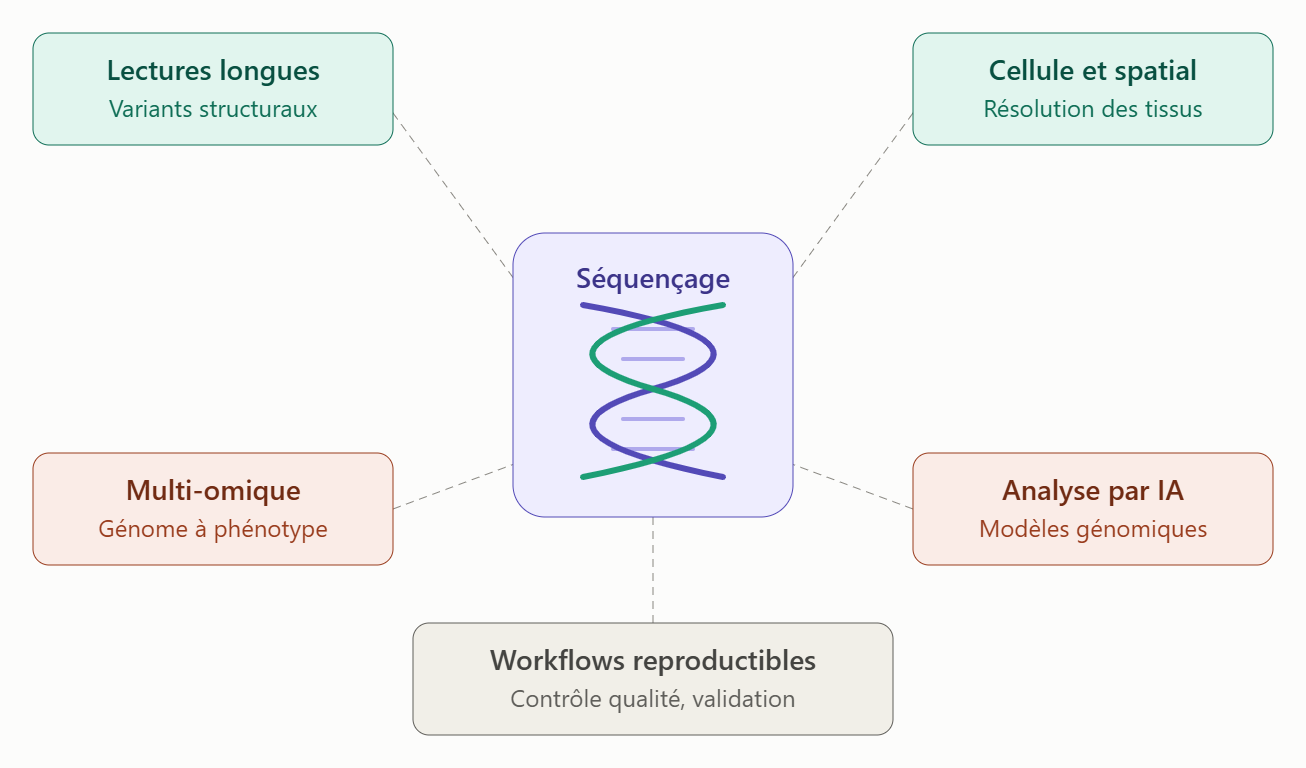
More comprehensive long-read analysis: Improved computational methods are expanding the ability to study complex genomic regions, structural variation, and haplotypes.
Single-cell and spatial approaches: Researchers are increasingly investigating molecular activity at finer cellular resolution and, in spatial methods, within the organization of tissues.
AI-assisted interpretation: Machine learning and emerging genomic foundation models are creating new possibilities for sequence analysis, variant interpretation, and the integration of biological datasets.
More integrated molecular research: Multi-omics approaches are helping scientists connect genomic information with gene expression, protein activity, and cellular phenotypes.
More reproducible analytical workflows: Standardized pipelines, transparent quality-control procedures, and robust validation will remain essential as sequencing becomes more integrated into research and clinical settings.
These developments do not eliminate the need for experimental validation or expert interpretation. Instead, they expand the range of biological questions that researchers can investigate.
The future of genomics will depend on combining increasingly powerful technologies with rigorous scientific reasoning.
Sequencing Is Only the Beginning
Next-generation sequencing has changed how scientists explore biological information. It enables large-scale genomic analysis, supports the study of gene expression, and provides new ways to investigate genetic variation and biological complexity.
Yet the most important advances occur when sequencing data become part of a broader scientific process: carefully designed experiments, robust bioinformatics, thoughtful interpretation, and independent validation.
As long-read sequencing, single-cell technologies, multi-omics, and artificial intelligence continue to evolve, NGS will remain an important component of modern biological discovery.
The real opportunity is not simply to read more DNA, but to understand more biology.