
Exploring Digital PCR Technology

Digital Polymerase Chain Reaction (digital PCR or dPCR) represents an advanced approach to nucleic acid quantification that enables researchers to measure target DNA or RNA sequences with high precision. By partitioning a sample into thousands or millions of individual reactions, digital PCR provides an alternative to conventional quantitative polymerase chain reaction methods, particularly when absolute quantification and the detection of low-abundance genetic targets are required.
Unlike real-time quantitative PCR, which estimates the quantity of a target by monitoring fluorescence amplification over successive cycles, digital PCR determines the concentration of a target by counting positive and negative partitions. This approach supports precise molecular measurements without necessarily requiring an external standard curve.
As molecular biology continues to evolve, digital PCR is becoming an important analytical technology for genomic research, molecular diagnostics, biotechnology, and the investigation of rare genetic variations.
Understanding the Principles of Digital PCR
Digital PCR is based on the physical partitioning of a nucleic acid sample into numerous individual reaction compartments. Each partition may contain one or more target molecules, or no target molecule at all.
Following amplification, fluorescent signals distinguish positive partitions, where the target sequence has been detected, from negative partitions, where no detectable amplification has occurred.
The proportion of positive and negative partitions is then used to estimate the original target concentration through Poisson statistical analysis.
How Does Digital PCR Work?
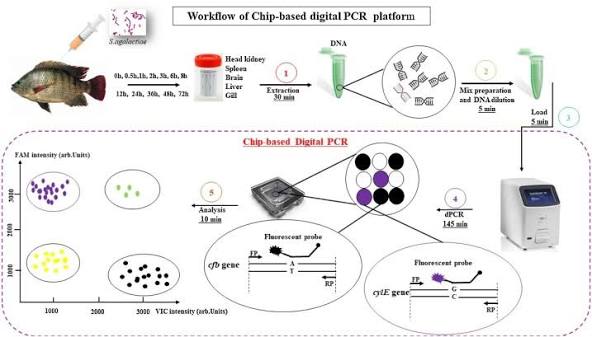
The digital PCR workflow generally involves five main stages:
Sample preparation: DNA or RNA is extracted and prepared for molecular analysis.
Reaction partitioning: The sample is distributed into thousands or millions of small reaction compartments.
Target amplification: PCR amplification occurs independently within each partition.
Fluorescence detection: Positive and negative partitions are identified according to their fluorescence signals.
Absolute quantification: Statistical calculations estimate the original concentration of target molecules.
This partition-based strategy transforms molecular amplification into a quantitative counting process, offering an alternative to traditional relative or standard-curve-based quantification.

Droplet Digital PCR and Chip-Based Digital PCR
Digital PCR can be implemented using different partitioning technologies. Two widely used approaches are droplet-based systems and microfluidic chip-based platforms.
Droplet Digital PCR
Droplet digital PCR (ddPCR) divides a sample into numerous water-in-oil droplets. Each droplet acts as an independent PCR reaction compartment.
After amplification, a detection system measures the fluorescence of individual droplets and classifies them as positive or negative. The resulting data are used to calculate target concentration.
Droplet-based systems are particularly useful for applications requiring sensitive detection, precise quantification, and analysis of low-frequency genetic variants.

Chip-Based Digital PCR
Chip-based digital PCR uses microfabricated devices containing predefined reaction chambers. The sample is distributed across these chambers, where independent amplification reactions occur.
This format offers controlled partition geometry and can support reproducible molecular measurements. Depending on the platform, chip-based systems may be suitable for targeted gene analysis, mutation detection, and quantitative genomic studies.
The choice between droplet-based and chip-based technologies depends on the analytical objective, sample characteristics, instrument availability, throughput requirements, and experimental design.

Major Applications of Digital PCR
Digital PCR has expanded the possibilities of molecular analysis by supporting precise measurements across a wide range of biological and biomedical research fields.
Rare Mutation Detection
The identification of low-frequency genetic variants can be challenging when a target sequence is present alongside a large excess of non-target DNA.
Digital PCR can help quantify rare mutations in complex genetic backgrounds, provided that the assay has adequate specificity and sensitivity. This capability is relevant to oncology research, somatic mutation analysis, and the investigation of genetic heterogeneity.
Copy Number Variation Analysis
Copy number variations involve differences in the number of copies of particular genomic regions between samples or individuals.
Digital PCR can quantify selected genomic targets and reference sequences to support copy-number estimation. It is particularly useful when researchers need to investigate relatively small differences in target abundance.
Gene Expression Research
Digital PCR can be used to quantify complementary DNA generated from RNA samples. With appropriate reverse transcription and experimental controls, researchers can measure transcript abundance and investigate changes in gene expression.
This approach may be valuable when transcript levels are low or when accurate measurements of specific molecular targets are required.
Viral Nucleic Acid Quantification
Digital PCR can support the quantification of viral DNA or complementary DNA derived from viral RNA. It can be applied to research involving viral replication, molecular assay development, and the characterization of viral genetic material.
Its suitability depends on the target, sample matrix, extraction efficiency, and validation of the analytical method.
Cell and Gene Therapy Research
Cell and gene therapy development frequently requires the characterization of nucleic acid products and genetically modified cells.
Digital PCR can contribute to measurements of vector genome abundance, transgene copy number, and other defined molecular targets. These measurements may support research, analytical development, and selected quality-control workflows.
Microbial Detection and Environmental Analysis
Digital PCR can also be applied to the quantification of specific microbial genetic sequences in complex samples. Potential applications include microbial ecology, environmental monitoring, and the study of microbial communities.
Reliable interpretation requires suitable controls for extraction efficiency, inhibition, contamination, and target specificity.
Sensitivity, Precision, and Analytical Reliability
Digital PCR is often selected when researchers need accurate quantification of low-abundance targets or small differences in nucleic acid concentration.
Its performance depends on several interacting factors:
Partition number and volume: These characteristics influence the measurable concentration range and statistical precision.
Assay specificity: Primers and probes must distinguish the intended target from non-specific sequences.
Sample integrity: Degraded nucleic acids and inefficient extraction can affect quantitative results.
Fluorescence classification: Appropriate thresholds are needed to distinguish positive and negative partitions.
Background interference: Inhibitors, non-specific amplification, and fluorescence variation may affect interpretation.
Experimental controls: Positive controls, negative controls, and appropriate reference materials help assess assay performance.
Although digital PCR can offer excellent analytical precision, it does not eliminate experimental uncertainty. Measurements should be interpreted alongside confidence intervals, replicate results, quality-control criteria, and the limitations of the specific assay.
Multiplex Digital PCR: Measuring Multiple Targets
Multiplex digital PCR enables the detection of multiple molecular targets within the same reaction using distinguishable fluorescent signals.
This strategy can support simultaneous analysis of a target sequence and a reference sequence, the investigation of multiple mutations, or the characterization of several genetic markers.
Multiplex assays may reduce sample consumption and increase analytical efficiency. However, assay development requires careful optimization of primer and probe concentrations, fluorescence compensation where applicable, signal separation, and the interpretation of overlapping or ambiguous signal populations.
A well-designed multiplex assay must demonstrate that each target can be detected reliably without compromising the performance of the other targets.
Data Interpretation and Statistical Analysis
Digital PCR produces data that require structured analysis rather than simple interpretation of amplification curves.
The principal analytical steps include:
Classification of partitions as positive or negative.
Evaluation of fluorescence amplitude and signal quality.
Estimation of target occupancy using a Poisson model.
Calculation of target concentration based on partition volume and assay configuration.
Assessment of uncertainty, controls, and replicate consistency.
The Poisson correction is essential because a positive partition may contain more than one target molecule. Without this correction, the proportion of positive partitions alone would not accurately represent the original molecular concentration.
Researchers must also consider the effects of threshold selection, false-positive signals, false-negative detection, and the presence of inhibitors. Transparent reporting of analytical settings and quality-control criteria improves reproducibility and facilitates comparisons between experiments.

Precision Through Molecular Counting
Digital PCR represents a significant development in nucleic acid quantification by transforming amplification into a partition-based counting process. Its ability to estimate target concentration through statistical analysis makes it particularly valuable for absolute quantification, rare mutation detection, copy number analysis, and selected applications in molecular biotechnology.
By understanding its operating principles, analytical advantages, and limitations, researchers can make informed decisions about when digital PCR is appropriate and how it can complement quantitative PCR and next-generation sequencing.
The integration of digital PCR into modern molecular research demonstrates how precise measurement technologies continue to expand the capacity to investigate complex biological systems at the molecular level.