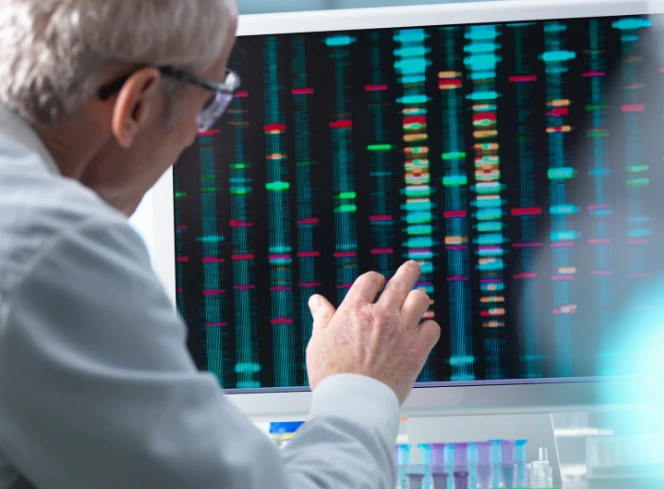
Advanced Molecular Quantification and Genomic Sequence Exploration
Three Technologies. One Molecular Perspective.
qPCR · dPCR · NGS
Measure with Precision. Quantify with Confidence. Decode with Depth.
Biological information exists at multiple molecular levels. Understanding it requires technologies capable of measuring nucleic acid abundance, detecting specific genetic targets, and exploring the sequence information that defines biological systems.
Advanced Molecular Quantification and Genomic Sequence Exploration brings together three powerful analytical approaches: quantitative polymerase chain reaction, digital polymerase chain reaction, and next-generation sequencing.
Each technology reveals a different dimension of molecular information. Quantitative polymerase chain reaction tracks amplification in real time. Digital polymerase chain reaction estimates target concentration through the analysis of individual reaction partitions. Next-generation sequencing investigates nucleotide sequences on a massive scale, opening access to genomic variation, sequence architecture, and complex molecular datasets.
Together, these technologies represent complementary approaches to molecular investigation, connecting targeted detection with precise quantification and comprehensive sequence analysis.
Our focus is the science behind these methods: how they work, what they reveal, where they differ, and how their analytical capabilities contribute to modern molecular research.
qPCR
Follow the Signal. Understand the Amplification.
Real-time quantitative analysis of nucleic acid targets.
Quantitative polymerase chain reaction transforms molecular amplification into measurable information. By monitoring fluorescence throughout successive amplification cycles, this technology enables researchers to evaluate target abundance and investigate differences between biological samples.
The relationship between fluorescence signals and amplification cycles provides the foundation for quantitative interpretation. Parameters such as the quantification cycle, amplification efficiency, assay specificity, and normalization strategy are central to producing reliable results.
From gene expression studies to targeted molecular detection, quantitative polymerase chain reaction remains a foundational technique in contemporary molecular biology.
Explore the science of qPCR
Real-time fluorescence monitoring
Amplification kinetics and quantification cycles
Relative and absolute quantification strategies
Gene expression analysis and normalization
Primer design and amplification specificity
Reference genes, controls, and experimental reproducibility
Standard curves, efficiency, and analytical performance
How does the amplification signal reveal the initial abundance of a molecular target?

dPCR
Count the Partitions. Resolve the Concentration.
Partition-based molecular quantification.
Digital polymerase chain reaction approaches nucleic acid measurement from a different analytical perspective. Rather than relying on the relationship between amplification kinetics and initial target quantity, the sample is divided into numerous individual partitions.
Following amplification, each partition is classified according to whether the target is detected. Statistical interpretation of positive and negative partitions, commonly using Poisson correction, enables the estimation of target concentration.
This partition-based approach can be particularly valuable when investigating low-abundance targets, small differences in nucleic acid concentration, or genetic material that requires sensitive quantitative analysis.
Digital polymerase chain reaction provides a distinct framework for molecular measurement, with performance influenced by partition number, assay design, sample quality, detection thresholds, and the characteristics of the target.
Explore the science of dPCR
Digital partitioning and endpoint detection
Positive and negative partition analysis
Absolute quantification principles
Poisson statistical correction
Rare-target detection and low-abundance sequences
Copy number variation analysis
Measurement uncertainty and assay validation
How can thousands of individual molecular reactions reveal the concentration of a target?

NGS
Read Beyond the Target. Explore the Sequence.
High-throughput sequencing for genomic discovery.
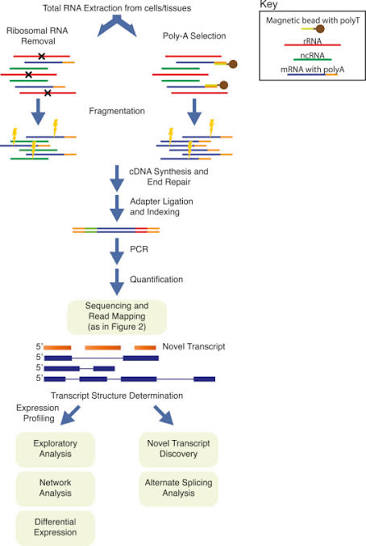
Next-generation sequencing expands molecular investigation from selected targets to large collections of DNA or RNA-derived sequences. By generating millions of sequence reads in parallel, these technologies enable researchers to investigate genetic variation, genomic organization, transcript abundance, and complex biological populations.
Unlike targeted amplification assays, sequencing can reveal sequence information across many genomic regions within a single analytical workflow. The resulting datasets can support variant identification, transcriptomic analysis, microbial characterization, and broader genomic investigations.
However, sequencing generates more than raw nucleotide reads. Meaningful interpretation depends on sample preparation, sequencing depth, quality control, bioinformatics, statistical analysis, and biological context.
Explore the science of NGS
Sequencing library preparation
Short-read and long-read sequencing principles
Sequencing depth and coverage
Read quality assessment and sequence alignment
Genetic variant identification
Transcriptome analysis and gene expression profiling
Genomic data processing and bioinformatics
Sequence interpretation and reproducible workflows
One Molecular Question. Three Analytical Perspectives.
Different methods. Different outputs. Complementary information.
qPCR, dPCR, and NGS are not interchangeable technologies. Their value depends on the biological question, the type of information required, and the analytical characteristics of the sample.
qPCR — Monitor
Follow amplification in real time to investigate target abundance and compare molecular signals across samples.
dPCR — Count
Analyze individual partitions to estimate target concentration using statistical interpretation of endpoint results.
NGS — Decode
Generate extensive sequence information to investigate nucleotide composition, genetic variation, and molecular complexity.
The choice between these technologies begins with the question being asked. Is the objective to compare gene expression, estimate the concentration of a specific sequence, or characterize a broad range of genetic information? Each objective requires an appropriate analytical strategy.
By understanding the principles behind these three approaches, researchers can make more informed decisions about experimental design, method selection, and result interpretation.

Where Quantification Meets Sequencing
Building a connected view of molecular information.
The integration of qPCR, dPCR, and NGS can provide complementary evidence in a broader molecular investigation.
A sequencing experiment may identify a genetic variant or reveal a candidate molecular target. A targeted amplification assay can subsequently be used to investigate that target in additional samples. Digital quantification may offer another analytical approach when estimating target concentration is a central objective.
Such workflows are not mandatory for every study. Their usefulness depends on the research question, validation requirements, sample characteristics, and the information already available.
The important principle is that each technology contributes a specific type of evidence. Combining them appropriately can strengthen molecular characterization while preserving the distinction between quantitative measurements and sequence-based findings.
A connected analytical workflow
Discover → Measure → Validate → Interpret
Discover: Use sequence analysis to investigate genomic regions, genetic variation, or candidate targets.
Measure: Apply targeted quantitative methods to examine the abundance of selected nucleic acid sequences.
Validate: Evaluate specificity, controls, reproducibility, and the suitability of the analytical method.
Interpret: Integrate the resulting evidence with statistical analysis and biological knowledge.
This framework illustrates one possible relationship between sequencing and quantitative molecular analysis, rather than a fixed workflow for every experiment.
Explore the Science Behind the Signal
A focused knowledge environment for advanced molecular technologies.
Our educational content explores the experimental principles and analytical concepts that define modern nucleic acid research.
qPCR and Real-Time Amplification
Understand fluorescence acquisition, amplification curves, quantification cycles, efficiency, and the interpretation of gene expression measurements.
dPCR and Absolute Quantification
Examine partition-based analysis, endpoint classification, Poisson statistics, concentration estimation, and the factors that influence digital measurements.
NGS and Sequence Intelligence
Explore sequencing technologies, library preparation, coverage, quality control, variant analysis, and the computational interpretation of genomic datasets.
Molecular Data Quality
Investigate contamination control, sample integrity, analytical specificity, experimental controls, and reproducibility across molecular workflows.
Bioinformatics and Statistical Interpretation
Understand how molecular measurements and sequencing outputs are processed, evaluated, visualized, and translated into scientifically meaningful results.
The Future of Molecular Analysis
More information. Better questions. Stronger analytical foundations.
Developments in molecular technologies continue to expand the possibilities of nucleic acid research. Improvements in fluorescence detection, digital partitioning, sequencing chemistry, automation, and computational analysis are creating new opportunities to investigate biological systems.
Quantitative amplification remains valuable for targeted measurement. Digital approaches continue to develop the possibilities of partition-based quantification. Sequencing technologies increasingly support investigations involving complex genomes, structural variation, transcriptomes, and diverse biological populations.
At the same time, greater analytical capacity introduces new challenges. Data quality, reproducibility, standardization, and appropriate interpretation remain essential regardless of the sophistication of the technology.
The next stage of molecular research will depend not simply on generating more data, but on selecting suitable methods and extracting reliable information from increasingly complex measurements.